Saturday, March 28
The 2026 Whitney Biennial Review
The 2026 Whitney Biennial
Friday, March 27
"When the wind dies down, and the rain grows gentle" (Sarah Imani) Review by Janine Olshefski
Revised Review:
When the wind dies down, and the rain grows gentle" (Sarah Imani) 56 Henry Street
Janine Olshefski
With the spike in popularity of contemporary art, it is hard to find works that I have an emotional connection to as an artist whose practice is rooted in traditional mediums such as colored pencil, oil pastels and graphite.
To keep up the expectations within the art world, many galleries have been focusing their attention towards the growing popularity of contemporary art. Which is why, when I stepped into the exhibit, “When the wind dies down, and the rain grows gentle” by Sareh Imani, it was especially eye-catching for me, not only because of Imani’s technical skills, but because of the reasons why she draws what she draws. Imani’s works are rooted in observations during her routine walks through the forests of upstate New York where she lives. She gathers materials from various stages of their natural life cycle. In order to preserve these materials, Imani casts sticks, rocks, leaves and more products of nature into plaster which she later uses to construct a still life set up from these organic forms to be drawn in her delicate, yet hyper realistic style. Her decision to use pastel pencils allows her to be precise, while the composition and scale of the pieces forces the viewer to take in the whole drawing by observing natural elements in a perspective that encourages the viewer to see the beauty of nature.
Cinga Samson “Ukuphuthelwa”
Ishana Sen Das
Cinga Samson “Ukuphuthelwa”
Cinga Samson’s exhibit at The White Cube embodies the isiXhosa word Ukuphuthelwa, which translates to “unable to sleep.” Samson uses shades of grey and white sparingly to convey human figures against dark backgrounds, as though the scenes are illuminated by only the moon. This careful use of color and light gives the impression of a dream or a memory imprinted in the mind. His work features characters with bright white, pupil-less eyes, adding to the insomniac feeling of his paintings.
In Ukuwelwa komda, the dynamic posing of the figures is reminiscent of a renaissance-style painting. The characters all feel deeply engrossed in what they’re doing, almost as if in a trance or carrying out a ritual. The painting, like others in the show, depicts a guardian-like bird at the top of the work, looking down at the humans.
As the press release explains, Ukuphuthelwa does not have the same negative connotation that insomnia has in English: “for Samson, sleeplessness is not a condition to be cured, but rather a state of spiritual alertness, a sensitivity that deepens in the dark.” Through Samson’s eyes, we experience this sensitivity in the way that his vision adjusts to the low light, but also through the level of detail that he captures.
Thursday, March 26
Review of Whitney Museum: 2026 Biennial
As one of the most important surveys of contemporary art in the U.S., the Whitney Biennial brings together a wide range of artists and works, offering a snapshot of the current artistic moment.
Unlike exhibitions with a clear theme, this Biennial feels more concerned with atmosphere and emotion. Many works explore connections between people, technology, and the environment, while also reflecting a sense of uncertainty and transition. The exhibition does not try to give clear answers. Instead, it presents a subtle tension between emotional atmosphere and topics like environmental issues and social instability in indirect ways.
Among the works on view, Michelle Lopez's Pandemonium stood out to me the most. Presented on a planetarium-like overhead screen, the work requires viewers to look up, creating an immediate sense of immersion. Fragments of newspapers and debris drift across the sky in a continuous loop, appearing chaotic yet carefully arranged. The circular format removes any clear beginning or end, reinforcing a cyclical system that the viewer is placed within rather than observing from a distance. This work reflects a broader concern in the Biennial: how individuals navigate systems of information and crisis. The work is visually compelling, but its ideas about information and crisis are not fully developed.
-Kaixin Lu
Thursday, March 12
Review of Guggenheim museum
Every single time I visit the Guggenheim, there is something great, and it was no exception for Carol Bove. The exhibition occupies the rotunda beautifully, showing a great amount of Bove’s pieces, from early conceptual work and drawings to some more recent monumental sculptures.
Bove’s sculptures appear with heavy material like stainless steel or scrap metal, yet they feel flexible and soft in their gestures, like they’re enjoying the crowd and dancing as an inflatable tube man in front of a restaurant. I find that to be satisfying to look at and experience the art, where there was an indescribable tension from the industrial material and unexpected delicacy.
A few of my favorite pieces were these metal “drawings”, featured with some really interesting colors. The colored shapes appear almost like glowing inserts or cutouts with the anodized background, giving me a strict but playful feeling at the same time.
The exhibition also reveals the evolution of Bove’s practice, which I later did a little bit of research on. Bove’s earlier work, incorporating bookshelves, found objects, or printed materials, emphasizes cultural references and intellectual associations, while the later large sculpture moves toward a more physical engagement with space and perception. Seeing her practice gradually shifting from more conceptual assemblage to something that’s kind of gestural abstraction in three dimensions is also quite interesting.
-iAN CHEN
Tuesday, March 10
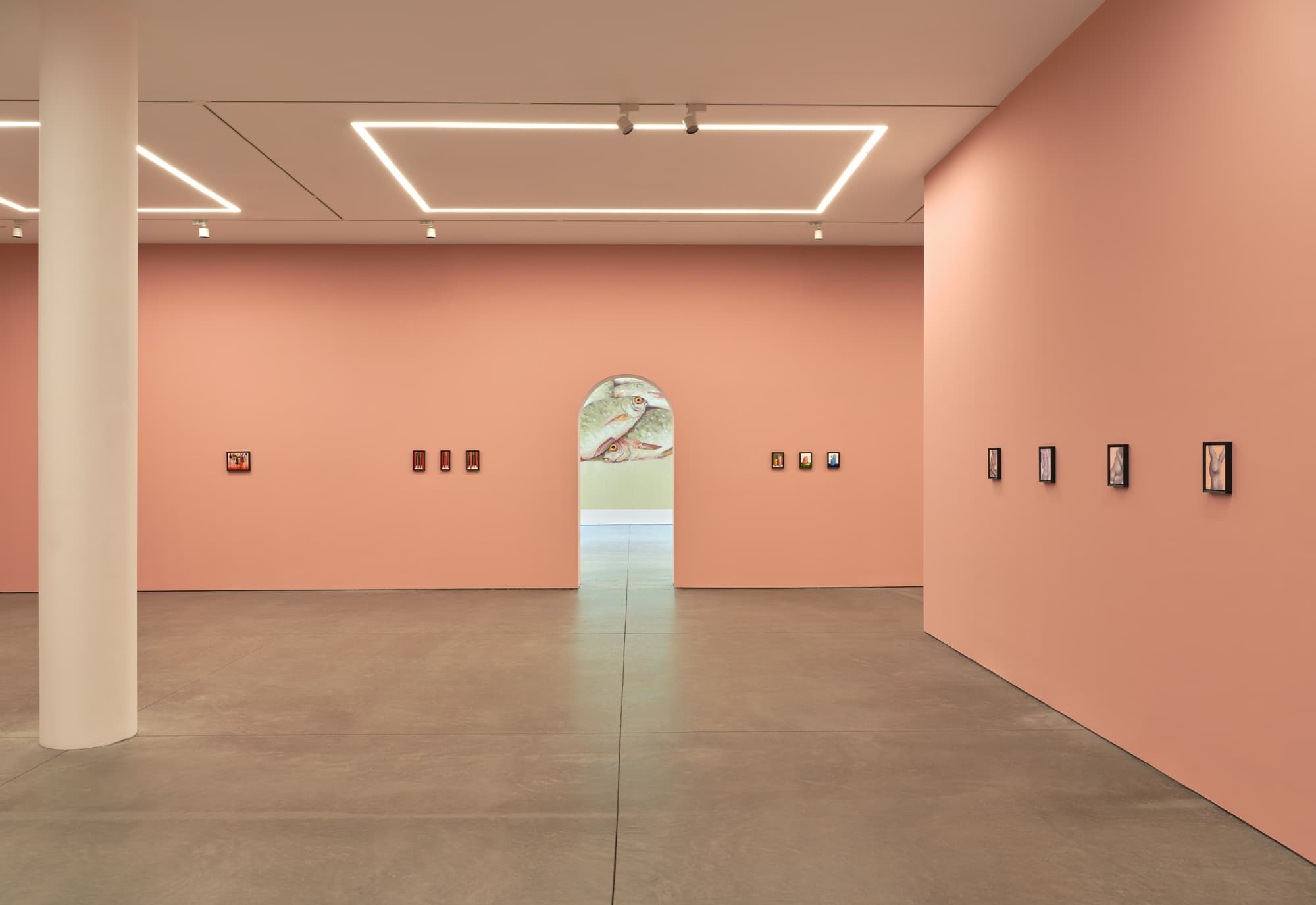
A Review of Nicolas Party's DEAD FISH at Karma Gallery
Nicolas Party's DEAD FISH
Karma Gallery
Reviewed by Marley Kinsman
After nearly two months of consecutive gallery visits there is one exhibition which still sticks with me- Nicolas Party's Dead Fish at Karma Gallery. In an effort to create something thrilling, something never before seen, artists lose their sanity and often end up painting an entire canvas one color. A self proclaimed "masterpiece", which is, in my opinion, garbage. Nicolas Party however, is bringing something refreshing to the table through reproducing not only paintings by the masters, but his own previous works as well.
The archway into the room and the limited view of his huge mural on the back wall draws the viewer into the space, and the sudden YET SUBTLE salmon pink walls are a shock to the eye. It feels like stepping outdoors into the light after being in a dark room for hours. One easter egg I noticed was the fact that if you take an image on a phone, the pink fades away. It is a phenomenon you can only experience in person. This is a unique way to create something you can only view in its fullest in person, like in Renaissance days.
This show is one of the most successful galleries featuring reworked and/or archival media in a long time. Party’s research and methodology is thorough and concise, creating not only a meaningful project but also just a beautiful selection of work.
Sunday, March 8
Review of Studio Museum
The now-reopened Studio Museum in Harlem has a massive array of artwork spanning medium and time. When you first enter the museum, you are surrounded by beautiful portraits by prolific artists such as Gordon Parks to Deana Lawson, looking down upon you in the salon-style hang. However, what the Studio Museaum has in specialty of artworks apart of the collection, it lacks in the quality of presentation.
I have never before thought that an artwork looked better online until my visit to the Studio Museum. After viewing Carrie Mae Weems' Untitled (Black Love) triptych, I could only say I was disappointed to finally see one of my favorite artworks in person. This amazing triptych features high-contrast deep-black silver gelatin prints; however, the glass used to frame it only veils the image. The reflections created through the mixture of glass and light clouds the image, destroying the tonal range, hiding the subtleties of the carefully made silver gelatin print.
For a museum with the stature to gather such a spansive infamous collection, I assumed that they would have the resources to present the work better. There are museum-grade glasses made to prevent this one issue, leading me to believe it comes down to an issue of finance. I trust this issue is not from a lack of care, which is clearly present in the curation and grouping of these artworks. Highlighting a sense of community and appreciation that the museum is clearly striving for.
-Lewis James
Friday, March 6
Review of Lotty Rosenfeld's Disobedient Spaces
The Wallach Art Gallery at Columbia’s show “Lotty Rosenfeld: Disobedient Spaces” is a
retrospective for the Chilean activist-artist. Archival documents are presented in tandem with
photography, drawings, and video installations highlighting Rosenfeld’s feminist interventions
and championing of the “No +” movement. The video installations included are the most
compelling use of gallery space, standing large and small across the rooms.
One piece displaying ants crawling up a wall in single file pushes the viewer to
contemplate the natural impulse towards obedience and order. Another large wall displays a
video of surveillance footage at a bank with an either erotic or painful moaning loudly playing
overhead. The use of sound mixed with this ominous video fills the viewer with an enthralling
and sickening anxiety. Rosenfeld’s video installations convey a terror and deep discontent with
the Chilean government in a manner that transcends historical knowledge. Instead she allows her
audience to step into the headspace of the people, particularly the women of Chile.
The gallery space highlights her interventions, and her work with other feminists of color
via photography documenting the events. Lotty Rosenfeld’s retrospective proves her
effectiveness in feminism and activism in Chile aside from the birth of the “No +,” as her video
imagery proves to say so much and crowds the gallery space with the justifiable anxiety of her
nation’s people and women around the world.
When approaching Kathy Butterly’s exhibition High Vibration, I felt as if I had entered a small garden of flowers. The square bases resemble stems, while the irregular forms above unfold like different blossoms. Each “flower” seems to generate its own miniature world, inviting viewers to move slowly through the space and observe the differences between each sculpture.
Each sculpture is cast in porcelain and placed on a handmade ceramic cube. Their shapes and colors vary greatly, and the texture of the glazes differs from piece to piece, ranging from the ultimate monochrome to richly detailed and complex treatments. Some surfaces appear smooth and quiet, while others feel more energetic and layered.
Rather than casting molds from found objects, Butterly develops her own vessel forms. She pours liquid porcelain into plaster molds and repeatedly reshapes the surface by hand, almost as if drawing lines in three-dimensional space. This process allows the forms to feel both controlled and spontaneous at the same time. The final shapes appear through glazing and multiple firings in the kiln, where the colors and textures gain their final intensity over time.
The placement of rounded vessels on top of cubic bases suggests a visual tension between organic form and geometric structure. However, when this same tension is repeated across many sculptures within the gallery space, the effect becomes somewhat diminished. The sculptures begin to produce an unexpected regularity. The lower cubes start to read primarily as pedestals, supporting structures rather than active elements of the composition. Because the cubic forms are relatively small compared to the circular ones and the display height is quite low, viewers must bend down to observe them closely, making the cubic bases easy to overlook.
Thursday, March 5
Lotty Rosenfeld: Disobedient Spaces Review
Born in 1943, Rosenfeld grew up in Santiago and lived through the U.S. backed 1973 coup by dictator Augusto Pinochet. The exhibition highlights the evolution of her work from early etchings to her videography and public art action. It opens with an eye-catching red wall with oversized prints taken from video footage of her pivotal work “Una Milla de Cruces Sobre el Pavimento”(1979) in which she laid white tape and bandages across traffic lines to create, as the title suggests, crosses on the pavement. Rosenfeld continued to speak out against Pinochet’s dictatorship with the art collective CADA, whose “NO+” campaign invited the public to finish the sentence “No More…” in their own words.
Seen today, Rosenfeld’s interventions feel simple yet radical. A strip of tape laid on the pavement is a visual interruption of authority and the status quo. Disobedient Spaces reminds visitors that small acts of resistance, particularly those carried out in the street during times of heightened military presence, can build visibility, solidarity and community under systems of oppression.
Revised Review of "Papunya Tula: Meeting Place for all Brothers and Cousins" at Foreign & Domestic (Group A)
Papunya Tula: Meeting Place for all Brothers and Cousins features a group of Aboriginal artists from the Western Desert of Australia. The approach of the series is to repeat abstract patterns, using organic lines and geometric shapes to depict the beauty of nature in their ancestral homeland. The color palettes are mostly red, black, and earth tones, representing the red sand desert. Although the Papunya Tula movement is a contemporary art movement that incorporates techniques from other styles, its subject matter, colors, and patterns draw inspiration from the ancient rock and cave paintings in Australia.
Review of "Disobedient Spaces" at the Wallach Gallery, Ksenija Carleton (Group A)
“Lotty Rosenfeld: Disobedient Spaces” –showing at Columbia University's Wallach Gallery until March 15th, is the first US retrospective of the Chilean artist. Remembered as one of the most influential feminist artists from Latin America, Rosenfeld’s artistic practice began in the early 1960’s, initially working with painting and prints, before transitioning to video-based and performance work in the wake of Augusto Pinochet’s military coup in 1973. Censorship, state violence, and female oppression are central themes in Rosenfeld’s work, and were in conversation with the brutality of the Pinochet dictatorship. Indeed, Rosenfeld explored artistic intervention as a means of political resistance.
The retrospective is organized into eight sections that follow loosely chronological and mostly thematic structures. Co-curators Julia Bryan-Wilson and Natalia Brizuela explore Rosenfeld's career via her early works on paper, videos, screen-prints, interventions like A thousand crosses on the pavement (1979-80), An American Wound (1982), No+ (as a member of the group CADA); and her decades long collaboration with Palestinian-Chilean poet Diamela Eltit. The sections bleed into one another, and the viewer's circulation in the gallery is somewhat unguided. However, rather than make for a confusing experience, this curatorial strategy reflects how politically and thematically unified Rosenfeld's body of work was. Indeed, her work was consistently committed to social justice, equality, and liberation of the oppressed. It would have therefore been arbitrary to divide her work along strict thematic, or medium-based lines.
In the wake of Columbia University's fierce repression of student protests in 2024, and its compliance with Trump’s efforts to undermine academic freedom, the Wallach’s exhibit is a rebuttal to the institution it is house in. "Disobedient Spaces" illustrates how the militant potentials of artistic intervention can be effectively harnessed, and the show's timeliness serves as an act of resistance in and of itself.
Ksenija Carleton
Review of New Museum : "New Humans: Memories of the Future," Anicka Yi’s “In Love with the World”
Review of New Museum : "New Humans: Memories of the Future," Anicka Yi’s “In Love with the World” By Evan Wu The reopening of th...
-
On View at the Hill Art Foundation, Jordan Casteel’s “Field of View” is a combined body of work from the ten most recent years of ...
-
Sarah Stevenson's work walks the line between drawing and sculpture. Her sculptures evoke geometric architectural drawings, but are...
-
Marian Goodman Gallery offered mystery and transcendence through Starless Midnight by Tavares Strachan. The exhibition began with Encyc...