Thursday, March 5

Lotty Rosenfeld: Disobedient Spaces Review

One might assume that Columbia University's Wallach Art Gallery would follow the policies of the university’s ongoing suppression of student led activism protesting ICE raids and the genocide in Gaza. However, Lotty Rosenfeld’s retrospective Disobedient Spaces, presents an uncensored point of view: political activism and collective art action are powerful tools to combat authoritarian systems of oppression. 

Born in 1943, Rosenfeld grew up in Santiago and lived through the U.S. backed 1973 coup by dictator Augusto Pinochet. The exhibition highlights the evolution of her work from early etchings to her videography and public art action. It opens with an eye-catching red wall with oversized prints taken from video footage of her pivotal work “Una Milla de Cruces Sobre el Pavimento”(1979) in which she laid white tape and bandages across traffic lines to create, as the title suggests, crosses on the pavement. Rosenfeld continued to speak out against Pinochet’s dictatorship with the art collective CADA, whose “NO+” campaign invited the public to finish the sentence “No More…” in their own words. 

Seen today, Rosenfeld’s interventions feel simple yet radical. A strip of tape laid on the pavement is a visual interruption of authority and the status quo. Disobedient Spaces reminds visitors that small acts of resistance, particularly those carried out in the street during times of heightened military presence, can build visibility, solidarity and community under systems of oppression. 


- Nicole Bunis


Revised Review of "Papunya Tula: Meeting Place for all Brothers and Cousins" at Foreign & Domestic Gallery (Group A)

    Papunya Tula: Meeting Place for all Brothers and Cousins at Foreign & Domestic Gallery features a group of Aboriginal artists from the western desert of Australia. The approach these artists take is to repeat abstract patterns, using organic curve lines and geometric square and diamond shapes to depict the sacred traditions of their ancestors and the beauty of nature in their ancestral homeland, Kiwirrkurra and Walungurru. The color palette is mostly red, black, and earth tones, representing the red sand desert. Although Papunya Tula is a contemporary art movement that incorporates techniques from abstract and minimalist styles, its subject matter, colors, and patterns draw inspiration from the ancient rock and cave paintings, sand art, and more traditional practices in Australia.


    The design of the exhibition provides an opportunity for each artist to express their style. Sally Nakamarra paints colorful grids representing the cave and water pond of Watunuma, one of their ancestral ruins. The short red strokes on black canvases representing the sandhills and the rocky hills are painted by Yalti Napangati. Aubrey Tjangala paints black on black, depicting body paint designs in the shape of their sacred water. Adrian Jurra Tjungurrayi paints organic dotted lines representing the bush carrot plants, and Angus Tjungurrayi paints monochromatic lines of the salt lake site of Wilkinkarra.

    This was my favorite exhibition because it honors the efforts in preserving their ancestral Dreamtime culture, a religion and mythology system before colonization, especially when their culture is not well-known in the world. The downside of combining contemporary art with traditional culture is that it becomes harder for audiences to distinguish which part is contemporary and which part is traditional. But overall, I appreciate having the opportunity to learn more about this culture from a very different part of the world.


Review of "Disobedient Spaces" at the Wallach Gallery, Ksenija Carleton (Group A)


    “Lotty Rosenfeld: Disobedient Spaces” –showing at Columbia University's Wallach Gallery until March 15th, is the first US retrospective of the Chilean artist. Remembered as one of the most influential feminist artists from Latin America, Rosenfeld’s artistic practice began in the early 1960’s, initially working with painting and prints, before transitioning to video-based and performance work in the wake of Augusto Pinochet’s military coup in 1973. Censorship, state violence, and female oppression are central themes in Rosenfeld’s work, and were in conversation with the brutality of the Pinochet dictatorship. Indeed, Rosenfeld explored artistic intervention as a means of political resistance.

The retrospective is organized into eight sections that follow loosely chronological and mostly thematic structures. Co-curators Julia Bryan-Wilson and Natalia Brizuela explore Rosenfeld's career via her early works on paper, videos, screen-prints, interventions like A thousand crosses on the pavement (1979-80), An American Wound (1982), No+ (as a member of the group CADA); and her decades long collaboration with Palestinian-Chilean poet Diamela Eltit. The sections bleed into one another, and the viewer's circulation in the gallery is somewhat unguided. However, rather than make for a confusing experience, this curatorial strategy reflects how politically and thematically unified Rosenfeld's body of work was. Indeed, her work was consistently committed to social justice, equality, and liberation of the oppressed. It would have therefore been arbitrary to divide her work along strict thematic, or medium-based lines. 

In the wake of Columbia University's fierce repression of student protests in 2024, and its compliance with Trump’s efforts to undermine academic freedom, the Wallach’s exhibit is a rebuttal to the institution it is house in. "Disobedient Spaces" illustrates how the militant potentials of artistic intervention can be effectively harnessed, and the show's timeliness serves as an act of resistance in and of itself.

                                                                                                                            Ksenija Carleton 

Thursday, December 11

"Education as Resistance" By La Escuela at MoMa PS1


Miguel Braceli’s large chalkboard stage


Studio Lenca's postcard workshop 


Laura Anderson Barbata’s naturally dyed flags

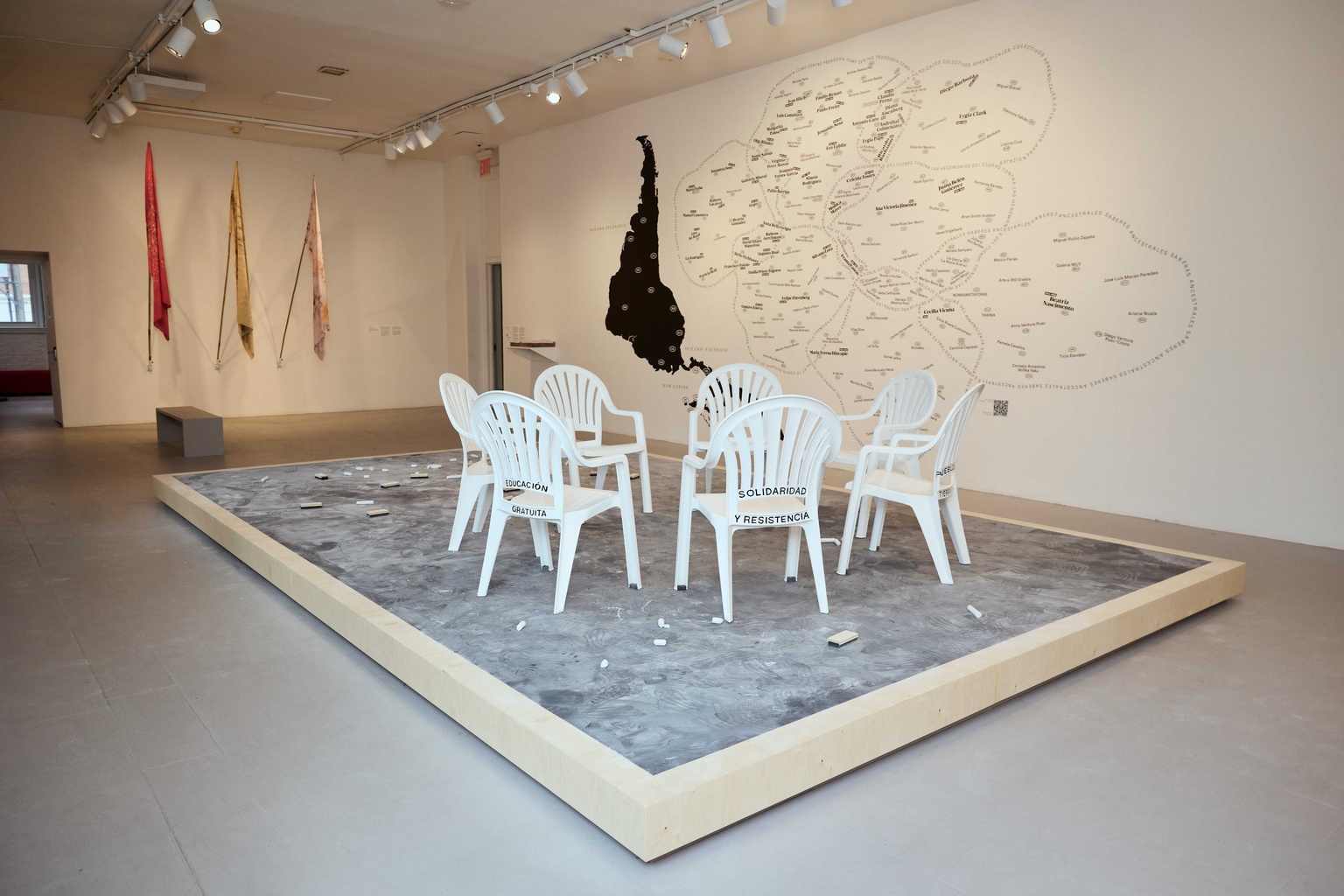
“Education as Resistance” is an installation by La Escuela, an artist-run project led by Siemens Stiftung and Miguel Braceli that uses art as a tool for social learning in public spaces across Latin America. For its first U.S. exhibition, the program transforms MoMA PS1’s Homeroom gallery into a collective classroom, framing education as a form of resistance against social injustice and colonial erasure. The exhibition highlights Latine activism through works by La Escuela’s collaborators.


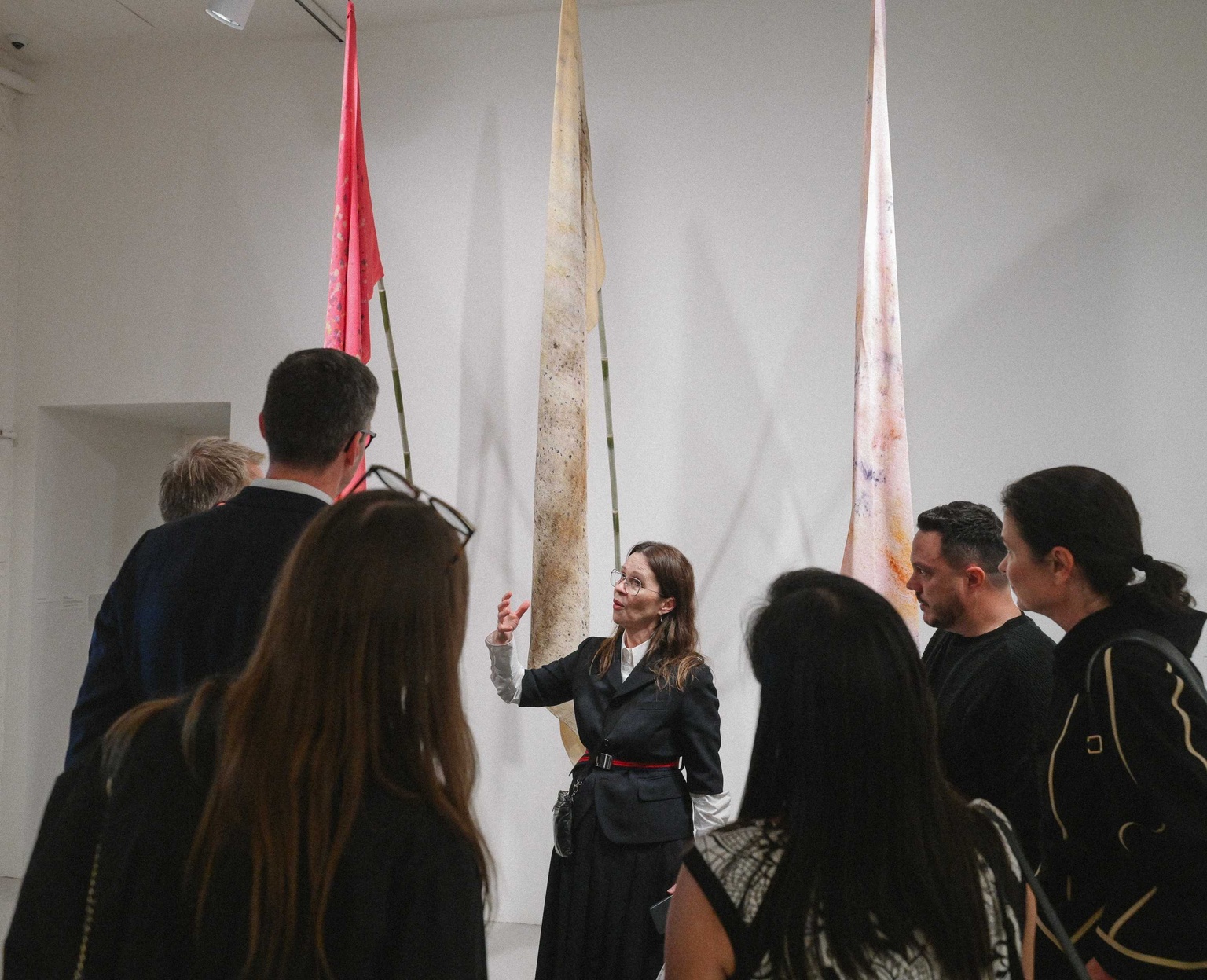
Among them, Laura Anderson Barbata’s naturally dyed flags, which are colored with pigments extracted from cochineal, rust, nuts, spices, and flowers. These materials invoke Indigenous knowledge passed down through colonial trade. Her process also links ancestral techniques to contemporary themes of gender, labor, and ecology.


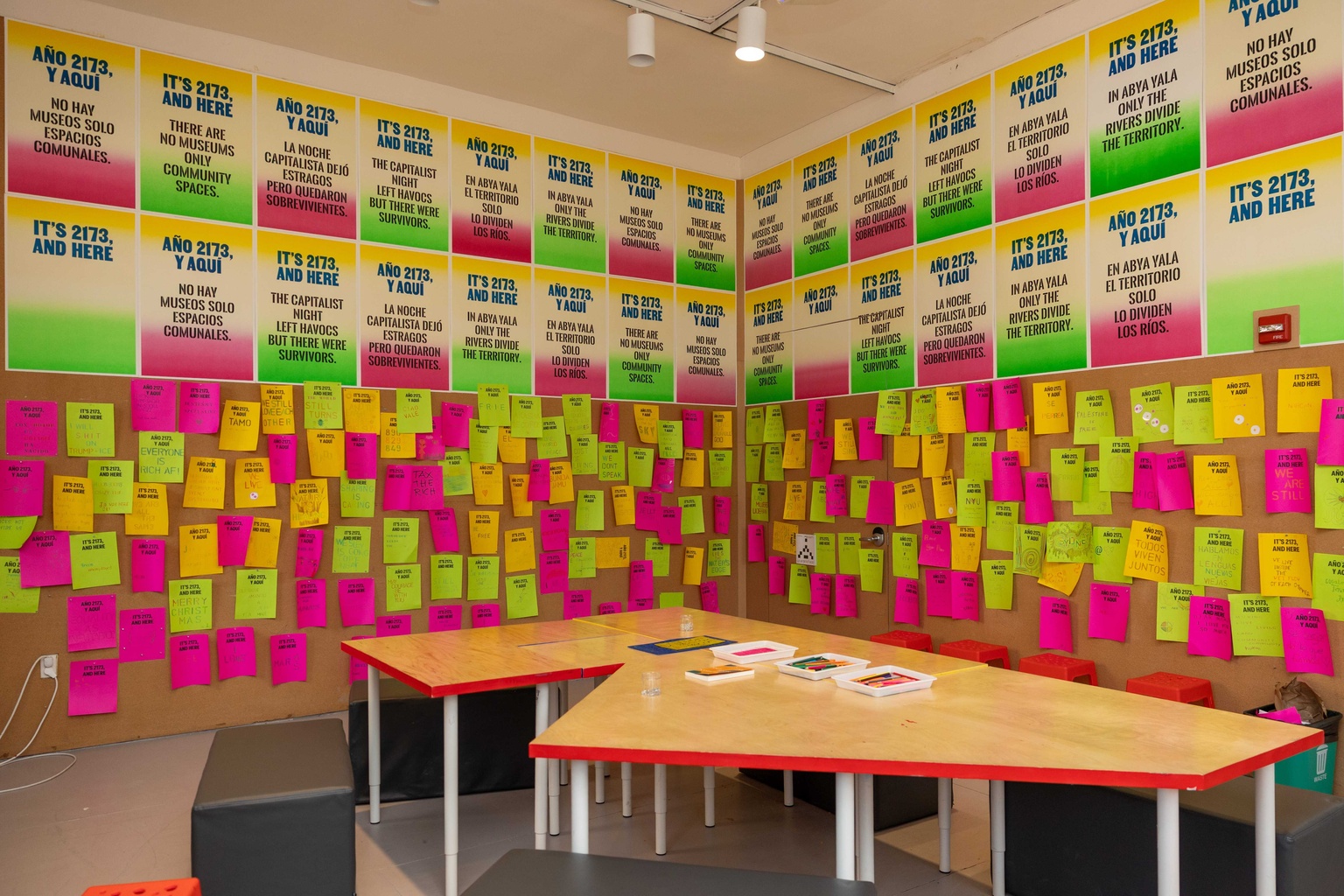
In adjacency, Studio Lenca offers a hands-on postcard workshop that invites visitors to reflect on the ideas of belonging and displacement. Both themes are central to his ongoing series Rutas. This participatory activity presents the migratory narratives derived from his broader practice.


Anchoring the space is Miguel Braceli’s large chalkboard stage, a flexible platform for gathering, writing, and sharing resources. It operates as both sculpture and furniture, emphasizing learning as an embodied, communal act grounded in everyday practice.


Presented as a functioning classroom, “Education as Resistance” creates a space for dialogue, co-learning, and collective expression. While the themes of the exhibition are clearly articulated through the works on view, some installations leave visitor participation ambiguous. More explicit invitations or prompts could clarify how audiences are meant to engage, which would strengthen the exhibition’s main intention.


Thursday, November 20


 These works share many similarities. Structurally, they all

demonstrate a kind of diffused state, yet visually they

converge at certain focal points. The first image, with its

urban landscape, immediately reminds me of materials

used in rock climbing. It suggests that the artist may be

exploring an opportunity to merge naturalistic elements

with a commentary on social conditions. To me, this piece

reflects on the “spectacle” of society—an existential

revelation of how we inhabit and perceive our

environment.

In the second group of sculptures, numerous human faces appear. This motif exists across many

cultural histories, yet the facial forms here evoke the aesthetics of the Americas—something

primal, an original beauty. The artist shapes the clay into smooth, refined surfaces, producing a

sensorial tactility. When displayed collectively, these figures remind me of Bizet’s Carmen—a

kind of silent theatricality. The work also brings to mind the ceramic pieces I saw at Marian

Goodman, though I believe this artist’s sculptures extend beyond references to agrarian

civilizations. They feel like a postmodern form of primal art. Moreover, by using different types

of clay, the artist introduces a sense of “union,” as though hinting at the gathering of different

peoples and cultures across the world.

The black sculptural work conveys a quality of black linear tension. This artist, represented by

David Zwirner, has long treated space itself as a canvas, playing extensively with negative space.

However, from a technical perspective, negative space alone does not fully account for the

work’s effect. While the materials and fabrication methods are not immediately clear, what is

directly perceptible is the piece’s persistent sense of instability—teetering yet stubbornly

resilient. Coming from my own Chinese cultural background, I associate this work with the

aesthetics of Go. It feels incredibly playful. Compared to the other pieces, this is the one I find

most compelling. The artist seems to create an internal set of rules, generating countless

variations from limited elements and forms. What emerges is a kind of silent poetry—an artistic

form of literature expressed through spatial rhythm and restraint.


   The work titled On the Hunt begins with an apparently calm textual study, placing more than a century’s worth of personal ads alongside surveillance-like imagery of hunters and animals, forming a powerful and thought-provoking metaphor. By examining the qualities men and women sought in each other from 1895 to 2019, the artist reveals both the changes and continuities in social values, gender expectations, and the structure of intimate relationships. When these texts are set into double-sided frames—one side showing the “hunter’s space” of elevated stands, the other presenting nighttime images of animals being watched and captured—the viewer can hardly ignore the sense of “pursuit” that often appears in human emotional life as well: who is searching for whom? Who is active, and who is being observed? With a restrained yet incisive approach, the work raises deep questions about desire, power, gender roles, and the consumerist nature of modern intimacy. It leads the viewer to constantly shift perspectives between reading and looking, as if oscillating between the roles of hunter and prey. In this way, the piece becomes not just a visual presentation but also a mirror that exposes the hidden structures within intimate relationships—sharp, honest, and revealing.

Friday, November 14

Detritus: Tom Friedman


From Tom Friedman's Detritus 

This painting captured my attention immediately through its strong contrast between density and calm. The lower half of the painting is a chaotic landscape composed of meticulously rendered fragments—geometric shapes, broken toys, wires, packaging, and unidentifiable debris. Each object is painted with obsessive detail, creating a kind of visual overload that feels both playful and suffocating. Aesthetically, this dense accumulation becomes unexpectedly beautiful; the colors, textures, and rhythms of the objects form an overloaded scene that mirrors the cluttered interior landscapes we carry within ourselves.

What transformed the work for me, however, was the tiny flying above it all. Against the vast, unbroken blue sky, the fly's delicate looping trail feels dreamlike, a thin path of freedom drawn across stillness. This tiny gesture shifts the entire emotional register of the painting. While the debris below feels heavy and earthbound, the fly suggests movement, escape, and an almost fragile clarity. It offers a way out—not by erasing chaos, but by rising above it.

Looking at the painting, I couldn't help but see my own mind in the contrast between the two halves. There are days when my thoughts feel messy, loud, and tangled, like the debris field. And there are moments when I want is to be like that fly—lifting myself out of the noise, drifting into a space that is quiet, clean, and open. The power of Friedman's work lies in this tension: he finds poetry in disorder, and within that disorder he plants a small, luminous sign of possibility. WC 256


Rebecca Ness: Inheritance

      I found this exhibit to be a refreshing homage to life and art culture. As I passed each work I felt as though I was in on the joke, b...